

A condensed version of what happened between the time Polynesian explorers first saw Hawai’i and when Hawai’i became the 50th state of the United States.
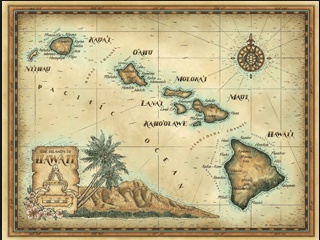
At around the 7th century, Polynesians from Tahiti and the Marquesas became the first people to settle in Hawai’i. They formed a unique culture to survive on these isolated islands. The settlers brought enough plants and animals to sustain a colony on the land they discovered. Upon their arrival on the Hawaiian islands, they developed an agricultural system that would eventually sustain a civilization of over 100,000 people by the late 1700s. The plants and animals they introduced included chickens, pigs, dogs, bananas, breadfruit, sugarcane, coconuts, ti leaves, ginger, and the holy grail: taro. According to Polynesian mythology, taro, or kalo as they called it, was believed to be humanity’s older brother.
Ancient Hawai’i had a strict caste system with four main classes: the aliʻi (chiefs and royalty), the kahuna (priests and professionals), the makaʻāinana (commoners), and the kauwā (outcasts and slaves). This system determined social roles, privileges, and restrictions, with the aliʻi at the top and the kauwā at the bottom. The people were governed by kapu, or religious taboos. Four distinct chiefdoms eventually emerged: Hawaiʻi, Maui, Oʻahu, and Kaua’i.
In January 1778, British explorer Captain James Cook became the first known European to visit the Hawaiian Islands. He was on an exploratory mission to find a Northwest passage to the Atlantic Ocean, and, after a brief stop, he continued to North America and Alaska. In November, he returned to the islands to resupply and explore the coasts of Hawai’i and Maui, then anchored in Kealakekua Bay on the Big Island in January 1779. Relations with the locals were initially good but began to deteriorate as some sailors clashed with the natives. Cook’s expedition sailed out of the Bay in February. A broken mainmast forced them to return to the Bay, and after a series of incidents, Cook was killed.
In 1810, King Kamehameha I united these chiefdoms into a single kingdom under a monarchy, which he ruled until his death in 1819. He was succeeded by his son, King Kamehameha II, who ruled until his death in 1824, followed by King Kamehameha I’s second son, King Kamehameha III.
In 1840, King Kamehameha III voluntarily gave up his absolute power in order to create a constitution. It established citizens’ rights and divided the government into executive, legislative, and judicial branches. Although King Kamehameha III remained in control of these branches, he worked with a House of Nobles and a House of Tenants who represented citizens’ rights. To protect Hawai’i from foreign incursions, King Kamehameha III sent delegations to the United States and Europe in 1842, resulting in recognition of Hawaiian independence in treaties signed by many of the world’s foreign powers the following year.
The Annexation Of Hawai’i
Aug. 12, 1898, Hawaiʻi became a Territory of the United States by annexation, at a formal noontime ceremony held in front of ʻIolani Palace.
What led to this event? In 1887, King Kalākaua was struggling with debt and political pressure from the business community (the sugar industry was very lucrative at the time). The Honolulu Rifles, a militia composed entirely of white residents, surrounded ʻIolani Palace with weapons and forced the king to sign a new constitution.
Called the “Bayonet Constitution,” it stripped most of the power from the monarchy and transferred it to a cabinet controlled by the business elite. Voting rights were restricted by property and income requirements that eliminated most Native Hawaiian voters while preserving the political power of wealthy foreigners. It was a bloodless coup that made future coups inevitable.
When King Kalākaua died in 1891, leadership of Hawai’i passed to his sister, Liliʻuokalani. The Hawaiian Kingdom was officially overthrown on January 17, 1893, in a coup against Queen Liliʻuokalani on the island of O’ahu. The overthrow was organized by the Committee of Safety, which consisted of seven foreign-born residents and six people born in Hawai’i living in Honolulu. Because Hawai’i did not have a standing army, the committee requested assistance from the American minister, John L. Stevens. Stevens ordered U.S. Marines and sailors to land, claiming their role was to protect the new government and prevent a possible Japanese intervention. After the overthrow, the committee created the independent Republic of Hawai’i, though their main objective was to have Hawai’i annexed by the United States.
The Queen’s statement regarding the coup said, in part, “Now, to avoid any collision of armed forces and perhaps loss of life, I do, under this protest, and impelled by said forces, yield my authority until such time as the Government of the United States shall, upon the facts being presented to it, undo the action of its representative and reinstate me in the authority which I claim as the constitutional sovereign of the Hawaiian Islands.” A few years later, Hawai’i became a territory, and in 1959, Hawai’i was given statehood.
This is a very brief version of the events, but hopefully it will help you understand the mindset of Native Hawaiians.

