

Understanding Their Roles
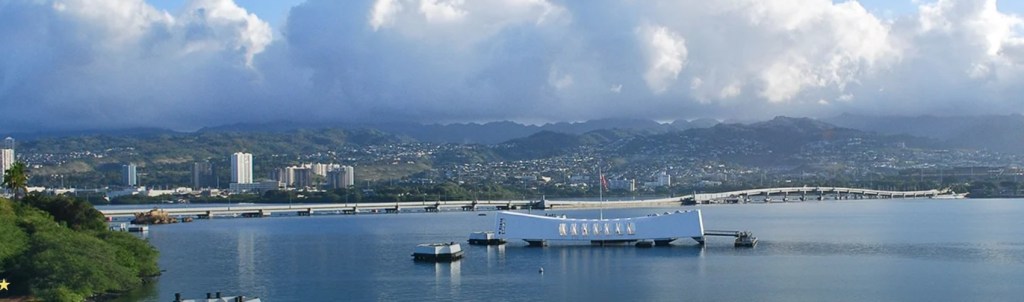
When visiting Pearl Harbor, guests are immersed in the area’s history and get a glimpse of how the United States military operates today and during wartime. Referred to as “the Pacific National Monument,” your visit offers a poignant glimpse into one of America’s darkest moments.
Preparing for Your Visit
Pearl Harbor is an active military base
As you explore the memorials and exhibits, remember that the site is located within an active military base. Please observe all “No Trespassing” signs and be mindful of regulations concerning purses, fanny packs, backpacks, diaper bags, luggage, and other types of bags. These items must be checked at the bag storage area near the Bowfin Submarine Museum and Park.
And because Pearl Harbor memorializes the personnel who died during the Japanese attack on December 7, 1941, it also reminds you that you are in a very solemn place. Please respect the lives lost and those who served by dressing modestly. Bathing suits and profanity-laden t-shirts are not appropriate. Park Rangers reserve the right to deny entry to individuals not dressed suitably.
What Sailors and Marines Do
Not technically separate branches of service
The Navy Mission Statement states, in part, that the “U.S. Navy protects America at sea” and “To defend American interests around the globe, the U.S. Navy must remain prepared.” Therefore, Navy personnel must maintain a constant state of readiness as a force that competes in the day-to-day, in crisis, and—if need be—in conflict. All personnel in naval service are Sailors first, and they are also officers, chiefs, petty officers, aviators, Seabees, surface warriors, and submariners.
The United States Marine Corps (USMC) is the maritime land force branch of the U.S. Armed Forces, specializing in expeditionary and amphibious operations. Officially part of the U.S. Navy, the USMC maintains installations on land and aboard sea-going warfare ships worldwide.
| Sailors | Marines |
| Sailors are responsible for the operation and maintenance of ships and submarines, ensuring mobility, logistics, and essential support at sea. Their mission emphasizes naval dominance, safe passage, and the support of combat operations through transport and tactical assistance. | Designed for swift, intense combat deployments and often the first to arrive in conflict zones, Marines specialize in amphibious warfare. They excel at storming beaches, securing territories, and establishing footholds to support further military operations. Additionally, several Marine tactical aviation squadrons, primarily Marine Fighter Attack squadrons, are integrated into Navy carrier air wings and operate from aircraft carriers. |
Roles Aboard a Ship
| Sailors oversee the full operation of the ship, handling tasks from navigation and engineering to medical care and supply logistics. | Marines are primarily onboard as passengers, and their role is to remain mission-ready for land deployments. Marines are generally stationed on the ship temporarily as they travel to mission zones. |
| They are responsible for day-to-day operations, ship maintenance, and ensuring readiness. | They focus on ship security, training, maintaining combat gear, and preparing for landing operations. |
| The Navy’s culture is grounded in maritime tradition, technical expertise, and teamwork across various specialized roles. | Marines are known for their intense pride, loyalty, and fierce warrior ethos. Their culture emphasizes toughness, resilience, and a “first in, first out” mentality. |
| Navy life emphasizes operational discipline and the adaptability required for life and missions at sea. | Marines view themselves as elite fighters, placing a strong focus on brotherhood and unwavering mission readiness. |
The Times are Changing
Integrating Operations
In a famous line from the movie, *A Few Good Men*, Lieutenant Kendrick said, “I like all you Navy boys. Every time we’ve gotta go someplace to fight, you fellas always give us a ride.” This line reflects the traditional roles once considered by the Navy and Marine Corps.
But times are changing. Traditionally seen as a force that launches from sea to shore, the U.S. Marine Corps is now reimagining its role with a new focus: exerting influence directly at sea to disrupt and control adversaries. Now, there’s a movement to flip the script and envision Marines making an impact at sea. The two forces are working more closely together to integrate their operations. This connects diverse sensors, weapons, and combat systems into a unified force.
Despite the playful rivalry, a solid foundation of mutual respect exists between sailors and Marines. Sailors acknowledge the bravery and resilience of Marines who risk their lives on land. At the same time, Marines recognize sailors’ crucial role in ensuring they arrive safely, well-equipped, and ready for their missions. In times of conflict, both branches depend on each other to accomplish their shared objectives.
The Navy and Marine Corps work together to:
- Respond to global crises
- Prevail in day-to-day competition
- Secure key maritime terrain
- Contribute to sea control
- Enable Joint Forces’ access
- Strengthen alliances and partnerships
Even if a Sailor or Marine has a non-combat duty assignment during peacetime, they are cross-trained in multiple skills, and the training will “kick in” if necessary. A prime example of why service members train in multiple skills is the story of Doris Miller.
Doris “Dorie” Miller
An unlikely hero
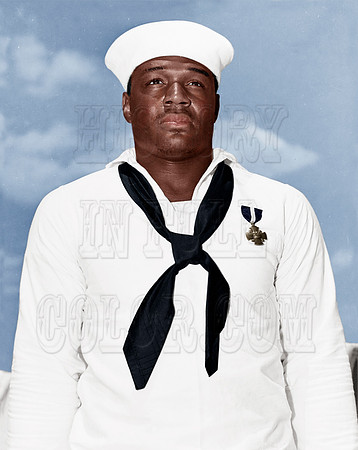
Doris Miller was born in Waco, Texas, and joined the Navy in September 1939 as a Mess Attendant Third Class. Mess attendant was one of the few ratings open to black sailors at the time. On December 7, 1941, while stationed on the USS West Virginia (BB-48), he demonstrated remarkable bravery and dedication during the Japanese attack on Pearl Harbor.
When the Japanese attacked Pearl Harbor, Miller was below deck doing laundry. As the alarm sounded and the crew was called to battle stations, Miller made his way to a gun magazine amidships. After a torpedo struck and damaged the magazine, Miller began to carry the wounded to safety. Among those he assisted was the ship’s commander, Capt. Mervyn Bennion, who was critically injured. Miller then took over a .50-caliber antiaircraft gun and continued to fire at the enemy until he exhausted the ammunition and received orders to abandon ship.
Miller’s bravery during the attack earned him a commendation from Secretary of the Navy Frank Knox and the Navy Cross, which was awarded to him personally by Chester Nimitz, commander of the U.S. Pacific Fleet, on May 27, 1942. He was the first Black sailor awarded the Navy Cross for valor. Miller lost his life in 1943 when the escort carrier Liscome Bay, on which he served, was sunk by a torpedo off Butaritari Atoll in the Gilbert Islands. The Navy commissioned a frigate named USS Miller on June 30, 1973, to honor his memory.
The Pacific National Monument
A must-see exhibition. There are many stories of uncommon bravery during the attack on Pearl Harbor, and you can learn about them at the Pacific National Monument. Your visit will give you a profound connection with those who defended and sacrificed their lives to protect their comrades and their country.
 Helster777