

Mai huhū iā Pele! Don’t anger Pele!

THE ANCIENT HAWAIIAN LEGEND OF MOLOKINI
As Hawaiian legends go, this one is reasonably consistent: The fire goddess, Pele, was in love with a prince (who took the form of a Mo’o – or sacred lizard), but the prince fell in love with another woman. In her fury, Pele took revenge, and, depending on which version of the story you hear, Pele rendered either Mo’o or the woman in half in a jealous rage. According to the legend, Molokini is the tail end of the Mo’o, and the head is “Red Hill,” the red cinder cone of Pu’u O’lai across the channel. Legends of Molokini and stories may differ, but the fact remains: You don’t toy with Madame Pele’s emotions.
MOLOKINI ISLAND
Molokini Island, just off the West coast of Maui, is not really an island but an islet – a tiny island with minimal vegetation and uninhabited. The more scientific, yet less romantic, version of Molokini’s creation suggests that it is most likely the result of a volcanic eruption dating back approximately 230,000 years. While the neighboring Haleakalā volcano has erupted dozens of times since that date, this is generally believed to have been the initial event that formed the caldera we snorkel in today. Originally part of the island of Maui, it’s thought that the melting of the ice caps at the end of the last ice age caused sea levels around Molokini to rise by 400 feet, surrounding the entirety of the Molokini caldera with water.
POLYNESIAN VOYAGERS

Researchers estimate that the Polynesian voyagers first discovered Hawai’i and Molokini around 500 AD. Based on the evidence found there, the ancient Hawaiians appear to have been fishing around Molokini for many years. The crescent shape forms sheltering arms favored by coral reefs, and these reefs are home to an abundance of fish and other marine life. Although no evidence exists that Molokini was ever permanently settled (fresh water is scarce on the dry, sloping rock), discoveries of stone sinkers and fishing lures by SCUBA divers suggest that the waters within Molokini were used as a food source, providing a healthy supply of marine life and fish. But not all its residents are located below the water. Birds nesting on the islet were gathered for their plumage and eggs, thereby making Molokini a resource for early Hawaiians by sea as well as by land.
HAWAIIAN FISHERMEN
Molokini provided an excellent fishing ground for Hawaiians, who trawled its calm morning waters with nets made of ‘olona (a shrub in the nettle family), firebrand, and stone sinkers. These ancient Hawaiian relics can be as big as your hand. Hawaiian fishermen also used to chew bits of the kukui nut and spread them over the water’s surface to make the water clear and glassy. This enabled them to see what was going on underwater. Hawaiians’ ingenious fishing methods were not limited to nets, baits, and nuts; they also included the use of medicinal plants that temporarily stunned fish, causing them to float to the surface.
DISCOVERING THE VOLCANIC ISLET OF MOLOKINI
For the rest of the world, the volcanic islet of Molokini was uncharted until French explorer Jean-Francois de Galoup recorded it in 1786. Captain Cook’s crew, who left the islands in 1779 after their captain’s death, never mentioned Molokini. Likely, they had too many other stories to tell about their time on the islands.
In 1883, King David Kalakaua hired two U.S. engineers to survey Molokini. The company they founded, Alexander & Baldwin, is now well-established in the islands, and in 1911, a navigation light was installed on Molokini.
ANCIENT HAWAIIAN RELICS FOUND AT MOLOKINI

You may still find ancient Hawaiian relics from the old fishing days in the waters of Molokini. If snorkelers or SCUBA divers find large, smooth stones that appear to have been worn smooth by waves, these were likely brought in by Hawaiians for a fishing practice known as palu (chum). The palu was a bait mixture of ground fish, octopus ink, and plants. The palu was tied to a hook, wrapped in a coconut leaf, attached to the stone, and dropped into the sea. The fisherman then yanked the cord, opening the package of palu down current. This practice attracted bigger fish to the area to feed.
Other ancient Hawaiian relics modern divers seek are the teardrop sinker stones known as pohakialoa (long stone), which were up to 10 inches in length. These stones have been spotted at depths of up to 180 feet.
MOLOKINI’S HISTORY & WAR
Sadly, Molokini’s history took a dark turn during World War II. Following the attack on Pearl Harbor in 1941, martial law declared the islands “federal property” to be used as bombing practice for the military.

The military selected the island for target practice because its narrow shape made it comparable to submarines and battleships. The bombing profoundly damaged the islet, the reefs, and the life they contained.
After this bombing, many surviving animals fled to other areas, and the fishermen refused to risk their safety by visiting the island.
During World War II, the navigation light was extinguished for security. Then, after the war, a wooden lighthouse was built – the third in Molokini’s history. This structure lasted 42 years before succumbing to the elements. Nowadays, a solar-powered stainless steel light tower marks the islet and is serviced via helicopter by the U.S. Coast Guard.
Aside from the bombing, Molokini Crater was also frequented by black coral divers harvesting large quantities of the precious resource, which eventually found their way into high-end jewelry stores. That, combined with the detonation of an unexploded bomb in 1975, which destroyed a large chunk of live coral, led to a public outcry that would ultimately result in the establishment of Molokini Crater as a Marine Life Conservation District in 1977.
MOLOKINI CRATER AS A MARINE LIFE CONSERVATION DISTRICT
The reef is now monitored by the Hawai’i Institute of Marine Biology, the University of Hawai’i Marine Options Program, and the Division of Aquatic Resources.
With the establishment of the Conservation District, a new era for Molokini Crater began. Local divers got involved to remove the remaining ordinance, risking their lives to save the existing reefs. In the years since, not a single remaining ordinance has been found by the many divers frequenting the area. This is great news as Maui snorkeling tours, private charters, and whale watching offer some of the best views of the abundant life in and around Molokini crater.
Molokini has become a world-renowned snorkel spot because of its excellent visibility, up to 80 feet. It has an area of 23 acres and is almost half a mile wide. The water depths range from only a foot near the shore to 20-50 feet in most dive spots to over 300 feet at its deepest points. There are many options for exploring the crater, depending on what you want to see. For shallow-water snorkeling, the protection of the crescent-shaped crater makes for a very comfortable and serene swim.
When you take a Maui snorkeling tour to the crater between December and April, you will surely see humpback whales as they migrate through the islands to their breeding grounds. When you swim or snorkel during whale season, you can actually hear the whales singing! Their songs are otherworldly, and the sounds can carry for several miles. For the photographer, the best time to capture pictures of these fantastic creatures is to take a morning boat trip to Molokini, so the soft, golden light will frame your view.
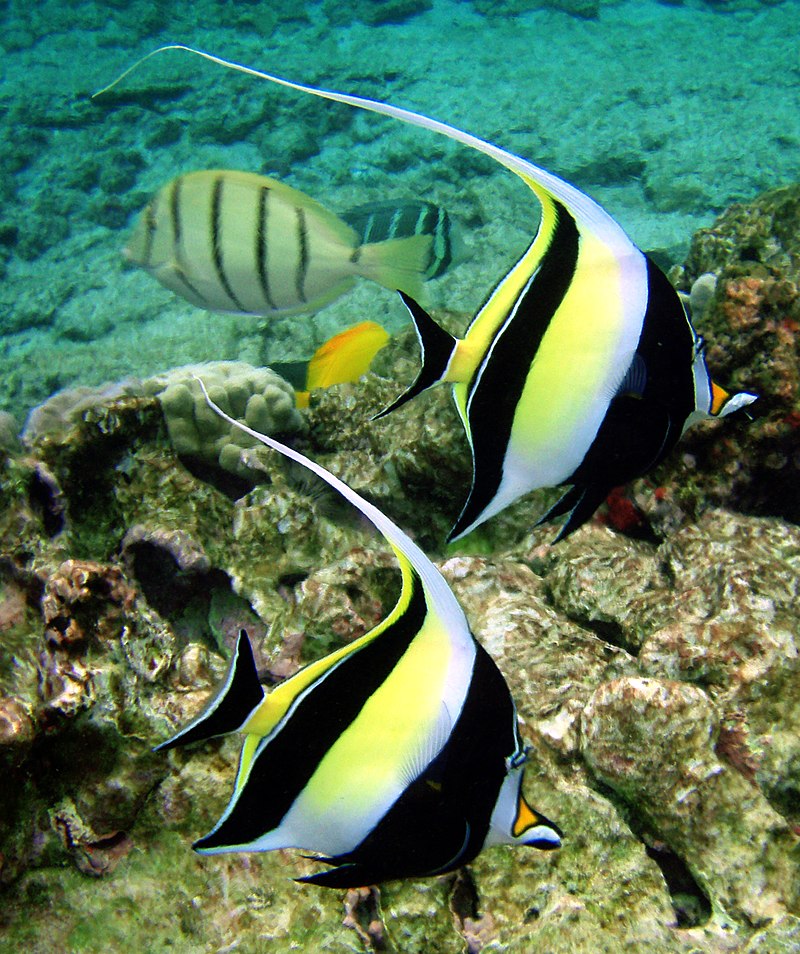
While snorkeling at Molokini Crater, you will also want to visit the snorkeling site called Turtle Town. Appropriately named, this spot off the south Maui coast is home to an abundance of Hawaiian green sea turtles. In fact, the incredible variety of sea life makes Molokini one of the best snorkel spots in the world. It is estimated that over 250 species of fish can be found there, along with approximately 100 species of algae and 38 species of hard coral. If you are lucky, you may also see moray eels, octopus, or manta rays. When snorkeling, look for the Humuhumunukunukuapua’a (say that five times fast!). It is the state fish of Hawai’i and part of the Triggerfish family. This brightly colored fish has a snout like a pig, which gives it the ability to blow air from its mouth to sift through the bottom sand and get to the algae that it favors to eat. This fish does not like to be crowded, so you will want to view this beautiful little guy from a distance if you encounter him while snorkeling at Molokini Crater.
Along with the colorful fish, you will also find vibrantly colored sea urchins, shy moray eels, and a few white tip reef sharks. This shark is smaller than most of its cousins and is found mostly in shallow coastal reef-lined waters. And, unlike its cousins, it is mostly harmless. They are fearless and curious so they may come close to swimmers to check them out. Generally, they range from 2 to 6 feet in height. You can recognize them by the white tips on top of their fins.
For the more advanced divers, a trip to the backside of Molokini is a true bucket-list item. The southwest rim of the islet carries scars from the bombing during WWII, with jagged rock and ledges that look, well, bombed. But what remains on the islet’s backside is an underwater vertical wall that drops 350 feet.
SCUBA divers will enjoy the experience and challenge of the Molokini Backwall. This dive is an ideal spot for capturing pictures and videos in unusually clear waters. Visibility off the Backwall typically exceeds 100 feet, and you never know what may swim by. A lucky SCUBA diver may encounter larger animals like manta rays, whale sharks, and humpback whales during the winter migration.
Molokini Crater is the most heavily visited marine protected area in the world, attracting approximately 375,000 people annually, which translates to around 100 people in the water at any given time. Fortunately, Molokini’s deep waters and strong currents help mitigate physical damage to the coral reefs and pollution settling in the area.
Currently, there are several protections in place for Molokini, including limiting the number of boats and tours allowed in the crater at any given time. Since the early 1970s, pioneering members of the dive community, whose livelihoods depend on the quality of the reefs in their area, have championed the installation and use of mooring buoys to lessen the harmful effects of anchors on coral reefs. Over the years, the movement has gathered momentum and is now widely accepted as an effective solution to one aspect of coral reef degradation.
If you love to swim, snorkel, scuba dive, birdwatch, or simply experience the history of a new place, this destination is incredible. There’s no way to call your visit to Maui complete without a Molokini snorkeling experience.
 Helster777