
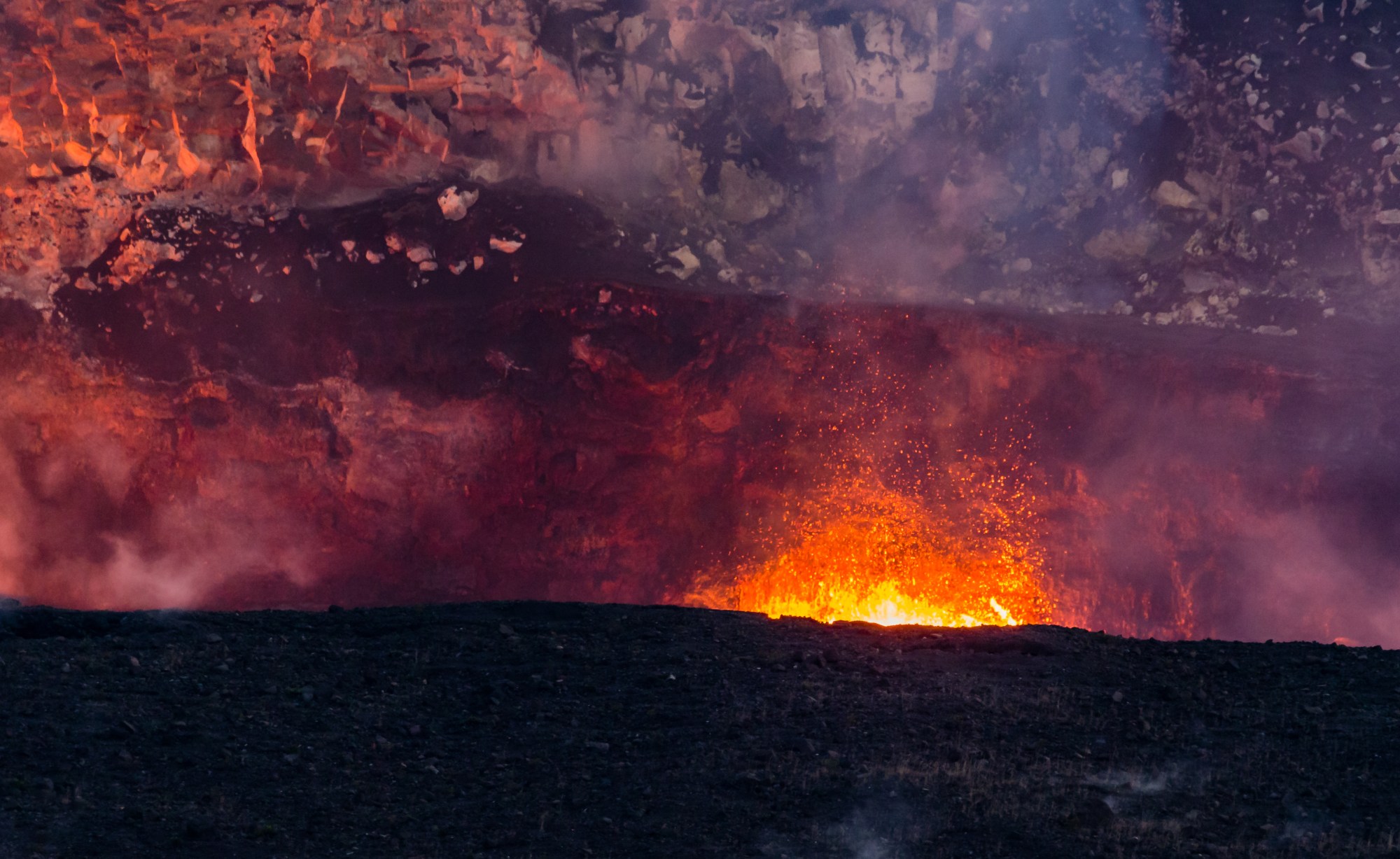
Most people will remember the international news about Kilauea erupting, as it was well-covered in the media. Numerous stories were circulating, and some confusion arose about what this meant to people with homes in the Puna district. It was especially worrisome to my husband and me as we owned a small house in Leilani Estates – the housing development hit hardest by the eruption.
In the spring of 2018, signs of increased volcanic activity were observed at Kilauea. The lava lake had expanded, indicating the accumulation of magma beneath it.
Before 2018, the summit’s lava lake had been active for many years, occasionally overflowing. However, on May 1, 2018, the Hawaii Volcano Observatory (HVO) issued a notice of potential eruption in Kilauea’s lower East Rift Zone. This was followed by a Magnitude-6.9 earthquake on May 4th, recorded on the south flank of Kilauea. Subsequently, the deflation of Kilauea’s summit began, leading to a drop in the Halemaʻumaʻu lava lake. By May 10th, the lava lake had disappeared from view. The following day, Hawaii Volcanoes National Park closed to the public.
When the lava lake began to disappear, it signaled that an eruption was underway, as the accumulated molten rock had to find a way out. The underground conduit between the lava lake and the downrift area suddenly widened by about 8 feet. This expansion allowed the magma, which had been accumulating under the caldera, to flow downhill underground towards Leilani Estates – a subdivision in the Puna district.
Madame Pele
In Hawaiian mythology, Pele, the goddess of fire, lightning, wind, and volcanoes, is said to reside in the Halemaʻumaʻu crater at the summit of Kilauea. Depicted as a young woman with long black hair and red lips, Pele is renowned for her fiery temperament. Legends warn that those who offend her may suffer death or heartbreak.
Small shrines with offerings popped up all around Leilani Estates. Interestingly, most local practitioners do not condone this practice. Offerings to Pele or any Hawaiian entities must be made with great care, or they can open a path for spiritual problems. The best option is that if a respected Native practitioner has not trained you, don’t do it. The perfect offering is one’s aloha (love) and ho`okupu (sacred word) to protect and honor the land and culture.
A Personal Account
My husband and I have owned property in Leilani Estates since 2012 and have a small cabin built in the lush rainforest. We felt fortunate to have found this beautiful piece of land, where we planned to retire in a few years. We were in Washington State when we heard of the beginning of the eruption. Knowing that our cabin was possibly in the volcano’s path, my husband, Al, needed to get there right away to salvage what he could out of our cabin if Madame Pele decided to take it.
The daily reports I received after my husband arrived on the island were nerve-racking. The National Guard made the right decision by blocking access to the subdivision, allowing only residents to enter. The crowds of people wanting to witness the volcanic activity posed a danger, and there was a risk that our properties would be exposed to looters. Although he was supposed to evacuate, my husband decided to stay as long as he could safely.
He told me the air quality was so poor that for the first couple of days, he stayed indoors, packing up our belongings and preparing to get out. In the distance, he could hear the explosive “lava bombs,” which sounded like mortar fire in a war zone. At night, when he lay in bed, he could feel the lava moving underground below the cabin.
Outside, “Pele’s Hair” was scattered on the ground and in the plants. Pele’s hair is a volcanic glass formation produced from cooled lava that has been stretched into thin strands. From a distance, you could see a layer of white, almost as though everything was kissed with frost. In addition, sulfur dioxide gases continued to spew from the fissures, and the vegetation in our beautiful jungle homestead was turning brown.
In late May 2018, the area of destruction from the volcanic activity significantly expanded, leading to heavy restrictions on access to surviving sections of Leilani Estate near the edges of the lava field starting May 31. Reports also emerged on July 1, 2018, of discussions among Hawaii politicians regarding a proposed ban on future home construction in areas prone to volcanic activity.
In the end, our cabin was spared. But many of our friends and neighbors were not so lucky. In the end, over 700 homes were destroyed. Fortunately, there was no loss of life, but 24 people were injured – some severely.
A Tale of Loss and Recovery
Eric and Diane Cohen were home on May 1st, 2018. Their property in Kapoho had been a haven for them, developed over the course of 35 years. As longtime Hawaii residents, they were pretty used to earthquakes and volcanic activity. Eric recalls that Diane was swimming in their above-ground pool with their dog when they felt a massive earthquake. The water was sloshing out of the pool – clearly, this was different from the typical rumbles. This magnitude-6.9 south flank earthquake was the largest recorded for Hawaii in 45 years.
They stayed in their home for the next few weeks as lava was not an imminent threat. For several days, they had already been having trouble sleeping when, on May 29th, they heard police with loudspeakers driving the road telling residents to leave. Eric recalls that he could see a red glow in the sky, so they gathered their things and left their home at 11 pm. As they drove away, they could see the glow of lava heading toward their home.
At this point, the old lava had been pushed out of the lava tubes, and now the new lava was flowing at more than 20 miles per hour, creating a river of molten rock. My husband described it as moving like white-water rapids. The rumbling of the flow felt like standing in front of the bass speakers at a heavy-metal concert.
While Eric and Diane stayed with friends, they monitored the developing news. For 38 days, the lava spared their property, and Eric got permission to walk in to check the status. He spent the night in the house and could see the river of lava in the distance. That was the last time he saw their home intact. The bottom slope of their property now sits buried under 80 feet of solid rock.
Even with the loss of their longtime home, Eric and Diane feel fortunate. They weren’t hurt and were able to find a nice piece of property where they have built a new home. It’s a little further away from Kilauea, and they still believe that even with Madame Pele as a neighbor, this is where they belong.
A New Normal
Eruption activity started to decline on August 5, 2018, with a noticeable decrease in the lava channel’s intensity and seismic activity at Halemaʻumaʻu in the following days. By August 15, 2018, the Lower East Rift Zone eruption had subsided, with no new lava entering the channel for over a week. Although scientists warned that the eruption could resume at any time, there was no further underground volcanic inflation recorded on instruments during that week, and no additional summit collapse events occurred, with only a small amount of lava remaining active.
Following this period, a small lava lake persisted within the cone’s crater for another three weeks. However, on September 4, 2018, the lava lake receded below the surface, marking the end of the eruption.
Hawaii County’s Voluntary Housing Program provided home and property owners with buyouts based on pre-disaster land values. The program’s purpose is for the County to acquire properties to prevent future eruptions and maintain the sites as open space. Hundreds of people in the affected areas have applied for the program.
As of this writing, work is being started to rebuild the roads covered by the eruption – a process that will take several years at least.
Those residents whose homes were spared are generally optimistic. The risk from the volcano was always present, and even now, due to this experience, many survivors are well-prepared for when the Goddess of Fire returns for another try. Besides, living on a volcano keeps one humble, and it doesn’t diminish the land’s beauty, whether during good times or bad.
A Chronology of Events
● April 30 Long-term Puʻu ʻŌʻō eruptive vent collapses; magma begins moving downrift toward Puna
● May 1 HVO (Hawaiian Volcano Observatory) issues notice of potential eruption on Kīlauea’s lower East Rift Zone. Deflation of Kīlauea’s summit begins and Halemaʻumaʻu lava lake starts to drop
● May 3 Onset of fissure eruptions on lower East Rift Zone; Volcano Alert Level raised to WARNING
● May 4 Magnitude-6.9 earthquake on south flank of Kīlauea
● May 9 HVO issues notice of potential summit explosions; lull in lower East Rift Zone fissures May 9-12
● May 10 Halemaʻumaʻu lava lake disappears from view
● May 11 Hawaiʻi Volcanoes National Park closes to the public (Kahuku Unit remains open)
● May 15 Aviation Color Code elevated to RED in anticipation of summit explosive events
● May 16 Onset of Kīlauea summit explosive events; HVO building evacuated
● May 19 Lava enters ocean near Mackenzie State Recreation Area (lasts about 10 days)
● May 25 Fissure 8 reactivates; new pit opens on the floor of Halemaʻumaʻu
● May 29 Caldera down drop accelerates: onset of near-daily summit collapse events, with each releasing energy equivalent to a magnitude-5+ earthquake
● June 3 Lava erupted from fissure 8 reaches ocean at Kapoho Bay
● June 24 Collapse events no longer producing ash; Aviation Color Code lowered to ORANGE
● Aug. 2 Summit collapse events end
● Aug. 4 Fissure 8 activity significantly decreases; summit deflation stops
● Aug. 17 Eruptive pause at fissure 8; Volcano Alert Level lowered to WATCH
● Aug. 21 Ocean entry no longer active
● Sept. 1-5 Sporadic glow/weak lava activity within fissure 8 cone; no active lava observed after Sept. 5
● Sept. 22 Hawaiʻi Volcanoes National Park reopens (details at nps.gov/havo)
● Oct. 5 Kīlauea Volcano Alert Level lowered to ADVISORY; lowered to NORMAL on March 26, 2019 – almost one year after the initial phases of the eruption
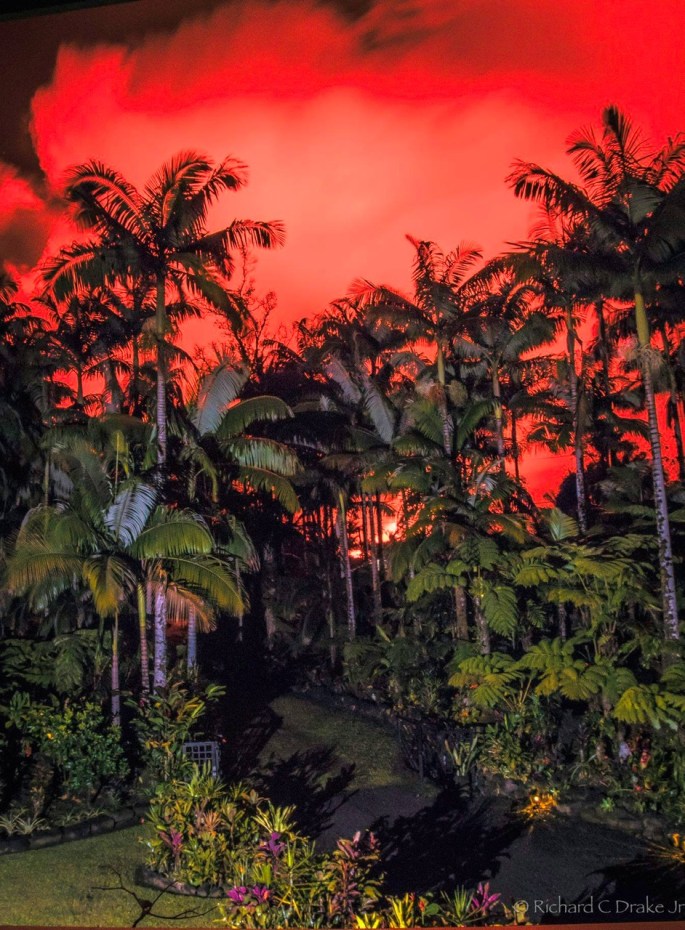
This photo was taken from the upper deck of our neighbor’s house. This was in the middle of the night, and the bright yellow glow you see in the middle is fire from the lava.
 Helster777