
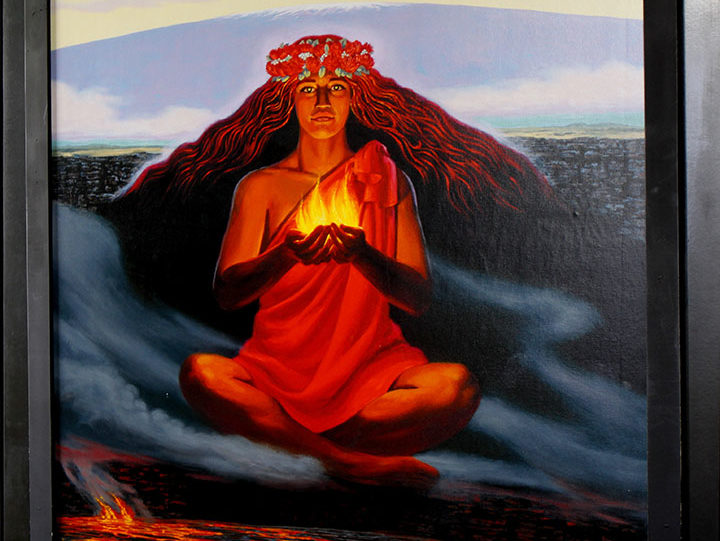
After months of increasingly frequent earthquakes, on November 27, 2022, the world’s largest active volcano awoke for the first time in nearly 40 years. The Mauna Loa volcano makes up roughly half of Hawaii island’s land mass, and the news of the event has spread worldwide.
“A volcanic eruption is a physical manifestation of so many natural and spiritual forces for Hawaiians,” said Ilihia Gionson, a Hawaii Tourism Authority spokesperson who is Native Hawaiian and lives on the Big Island. “People unfamiliar with that should understand that it’s a very personal and significant thing.”
Manua Loa’s spectacular show is drawing thousands of people hoping for views of the lava flowing down the volcano’s northeast side. Among them are Hawaiians coming to pay their respects, leaving offerings or shrines along the roadway. Many are taking part in a tradition passed down from their grandparents and other Native Hawaiians as a way to honor both the natural and spiritual worlds. They will make offerings and chant to Pele, the Hawaiian goddess of volcanoes and fire. Due to the current eruption, strands of Pele’s hair (volcanic glass) are falling in and around the Humu‘ula Saddle area.
Pele’s Role in Hawaiian Culture
In ancient folklore, Pele travels throughout the islands, appearing to mankind as a beautiful young woman or as an old woman, sometimes accompanied by a white dog. Pele is probably the most well-known Hawaiian deity, as she is the most visible.
Otherwise known as Pelehonuamea, “She who shapes the sacred land,” Pele sends rivers of lava down the mountainside, devouring small towns and entire forests – while creating new land. She has added more than 70 acres of new land to the island’s southeastern coast since 1983.
While her presence is felt throughout the island chain, she resides in one of the most active volcanoes in the world — at the summit of Kīlauea, within Halema‘uma‘u crater at Hawaii Volcanoes National Park on the Big Island.
Stories of encounters with Pele include drivers who picked up an old woman dressed all in white on a roadside in Kilauea National Park, only to look in the mirror to find the back seat empty. Others say Pele’s face has mysteriously appeared in their photos of the lava lake within the crater or molten lava flows. Among the people of the islands, Pele is revered and respected.
As revered as she is, tales of Pele are full of fierce feuds and jealous outbursts. One story tells of how Pele, one of six daughters and seven sons born to Haumea (the Earth goddess) and Kane Milohai (creator of the sky, earth, and heavens), came to Hawaiʻi after being exiled from Tahiti by her father because of her temper. She fought with her elder sister Namakaokaha‘i, the water goddess whose husband Pele had seduced.
Another legend is how the islet of Molokini, just off Maui’s coast, was formed. Pele was in love with a prince (who took the form of a Mo’o – or sacred lizard), but the prince fell in love with another woman. In her fury, Pele took revenge and rendered the woman in half in a jealous rage. According to the legend, Molokini is the tail end of the Mo’o, and the head is “Red Hill,” the red cinder cone of Pu’u O’lai across the channel.
How Hawaiians Honor Pele
Legend has it that you must leave an offering or gift to Pele to keep her happy and protect your home and family from her unpredictable destructive wrath of lava. Pele will protect you if you protect her and show appreciation for all she has overcome.
Offerings at the volcano and other sacred sites are part of Hawaiian tradition. The problem is that many of the offerings are done out of context, sometimes to the point of being offensive. Offerings to Pele, and other Hawaiian entities, must be made with great care and training, or they can open a path for spiritual problems. The best option is that if a respected Native practitioner has not trained you, don’t do it.
An example of good intentions gone wrong is the frequent sight of small shrines containing food, rocks, and even bottles of gin. To leave a food offering without knowing the appropriate protocols, you have no assurance of knowing exactly what you are feeding.
Gin, or other alcoholic beverages, is another inappropriate offering. That “custom” was started by the owner of the famous Volcano House, the hotel on the crater’s rim. He made offerings of gin to Pele in hopes of getting her to indulge in her spectacular fire shows, drawing tourists to his establishment.
In his forward to Van James’ book, “Wahi Pana,” the Hawaiian history authority, Edward Kanahele, is clear. He points out that people who come to these islands “are of many different philosophical and spiritual persuasions…For the tourist or resident who is not a practitioner [of the Native Hawaiian religion], a minimal duty would be that one has the intent of doing no harm. …One should take a moment to reflect… One should not leave any [physical] offering. One should not disturb or take any souvenir rocks or other material because such action affects one’s spiritual safety. Neither should one leave a spiritual or personal object…since that also affects one’s spiritual safety.
The bottom line: the most appropriate offering can be made without any tangible item being left behind. The perfect offering is one’s aloha (love) and ho`okupu (sacred word) to protect and honor the land and culture.
 Helster777